

Spatially Fractionated Radiation Therapy Innovative Approaches for Local Immunomodulation in Advanced Cancer Stages

The art of oncology is what many oncologists love about practising, but at the same time it is also difficult to learn. I had struggled with this over the last two decades, ever since I started my practice in radiation oncology, asking my contemporary colleagues, ‘Why are you choosing this particular option when there were several different options’. The answer would often be, ‘That’s what I have had the most experience with.’ As a result, as a young oncologist, I often had no idea which treatment was the best for all patients.
It may be frustrating as a learner, but I have grown to love these evidence-free zones of oncology, the areas where the National Comprehensive Cancer Network guidelines lists many—or no—options. Here is where we can be honest and engage in hard conversations with patients about what we don’t know and where the question “What’s important to you?” really matters.
Spatially fractionated radiation therapy (SFRT) falls into the so-called evidence-free zone.
SFRT is distinctive from the standard radiation approaches, as it treats the entire tumour with a non-uniform dose while staying within normal tissue tolerance of the surrounding structures. The advancement of physics and technology has provided more techniques to deliver SFRT. The inhomogeneous dose is designed/selected by the biological differences within the tumour, such as radiosensitivity, tumour aggressiveness or the nature of mutations in genes or pathways in given intratumor location. Since therapy involves delivering a relatively high but heterogeneous radiation dose to the tumour through a perforated screen with blocked areas, similar to an array of pencil beams, this is also called GRID THERAPY / LATTICE THERAPY.
SFRT does not attempt to treat the whole tumour like the conventional approaches.
Why SFRT:
The advantage of SFRT in medicine lies in increased firepower (high Biologic equivalent doses), increased precision and less toxicity. In addition, SFRT produces dramatic relief of severe symptoms, significant objective regression, above-average local control rates and minimal toxicity in palliative settings.
Biology of SFRT:
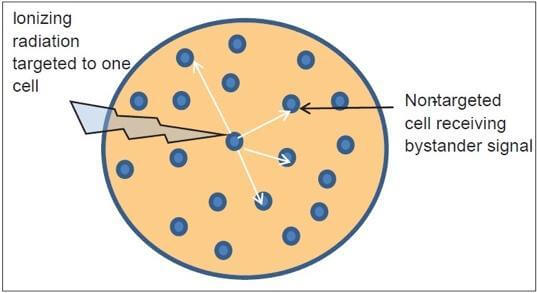
The current understanding of the biology behind GRID therapy may involve the bystander effect, vascular damage, and anti-tumour immune responses.
Bystander Effect:
The term bystander effect describes the ability of cells affected by irradiation to convey manifestations of damage to other cells not directly targeted for irradiation – changes happened in cells that are located in the valley (low dose) regions
Demonstrative Example:
This is the narrative of a 63yr old lady diagnosed with stage 3 breast cancer. She underwent surgery, chemotherapy, and chest wall radiotherapy two years ago and was on hormonal therapy. She noticed a swelling in the sternal area and immediately was put on 2nd line chemotherapy. Unfortunately, the lesion was progressively increasing in size and attained a size of 9 x 7 cm and was fiery red (hot). This was when she was referred for local palliative radiation therapy. While this appears to be a straightforward fractionation protocol, we decided to challenge the disease with spatially fractionated radiation therapy (SFRT).
SFRT is important in its concept of covering whole or partial tumours with inhomogeneous radiation doses and gives the field more creativity and complementary applications to supplement the standard school of radiation therapy. While clinical use of SFRT to date has been limited to select centres, most commonly for palliative or recurrent cases, SFRT does have the potential to treat primary cancers definitively, such as head and neck, lung, breast gynaecologic and sarcoma cases.
SFRT is an option that floats in evidence-free zones given the scientific rationale, technology prowess of newer tools and past experiences. The sustainability of the outcome with the adjuvant targeted therapy / Immunotherapy is to be seen.








 Best Hospital Near me Chennai


